Postcards from Seletar

Entries from August 2007

Goodbye Norma Jean in Hokkien

August 26, 2007 · No Comments

Last night several residents celebrated their respective birthdays - ranging from 4 to 52 years. There were many highlights, but one I know I will always remember is Xavier’s rendition of Elton John’s ballad - part of it elocuted in Hokkien, no less ;)

We are planning for the book launch at the end of September, probably to include a Nature Walk. We tried to book the Golf Clubhouse, but the quoted price for a 24 hour rental was just not affordable. Looks like another traditional Seletar garden party coming up, then.

Categories: Community · Creatives

WW2 memories

August 10, 2007 · 1 Comment

The Flora & Fauna edition of Postcards from Seletar is off at the printers, and it is time to start research for the Heritage edition. Browsing through the BBC website, I came across a section packed with personal memories.

Lieutenant Commander R. G. Curry VRD recalls

Lieutenant General Tomoyuki Yamashita had driven our armies out of Malaya, and on 31st January 1942, all who survived were now on Singapore- well over one million people crammed on an island about the size of the Isle of Wight, separated from the mainland by the waters of the Jahore Strait.

At the moment I was attached to the RAF at Seletar Airfield in Singapore as a Liaison officer, and we were under continuous bombing raids by the Japanese. Our Hurrican Fighters which had recently arrived from the UK and which I had helped to assemble, had flown away to Java, and the RAF were preparing to evacuate the base.

extracted from the diary notes of Mrs. Joan Dinwoodie, WREN

Earlier in the year we had been joined by 10 Wrens who had been diverted from Alexandria and contingent of 20 Royal Air Force personnel. At the end of November all leave for Army and RAF personnel was stopped, and on the 6th December 1941 all leave was stopped for us and we were confined to station and the telephone removed from the mess. On the 7th December Japan declared war. Rich and others were sent to Khota Bahru on the 6th and the Japanese landed there next day. However, Rich and colleagues arrived back at RAF Seletar safe and sound.

Eddy Maitland - From Schoolboy to Sunderland Pilot

So we flew a large number of mercy missions bringing out of Singapore and back to Madras British and Indian Prisoners of War and Internees on the first stage of their journey home. Our first of 21 trips between Madras and Singapore was made on the 19th September 1945 about five weeks after the atom bombs were dropped. The ex-POW’s were very thin and some of them were on stretchers. On the outward trips to Seletar near Singapore we carried mainly RAPWI personnel(Relief of Prisoners of War and Internees) We took off at night on Redhills Lake so as to make our landfalls in Malaya or on the Nicobar or Andaman Islands in the daylight.

letter from ‘Babe’s Uncle Ron to the latter’s parents Arthur & Daisy Collins, written a few days after the RAF entered Singapore in 1945. 110 (Hyderabad) Squadron, Seletar Aerodrome

Well, since I last wrote you, as you can see I have left Burma behind, and am now in a more or less civilised part of the world. We came down here two days before the Japs officially surrendered, and as you can imagine the people were absolutely delighted to see British uniforms again, after three and a half years of occupation…..

Categories: Heritage · RAF

HARP

August 5, 2007 · No Comments

The previous entry on 23 Amber Road needs to be augmented with information about HARP - I’ve taken this extract from Irene Low’s site, where the full FAQ can be found

What is HARP?
The Historic Architecture Rescue Plan is an interest group which was formed after the sudden and unnecessary demolition of a 1930s Art-deco building at Allenby Road which formerly housed the film archives of a local film maker. HARP members are known as Rescuers and all Rescuers believe there is a need to create an increased awareness of noteworthy buildings which may be in danger of demolition and deserve conservation.

To sign up, send an email to harp_rescue@yahoo.com

What does HARP aim to achieve?

HARP’s long term goal is to foster an environment where owners of heritage properties are aware of the social responsibility they shoulder as proprietors of such unique properties and will voluntarily come forward to offer to put their buildings on the URA’s conservation list. Through the collective effort of HARP Rescuers, HARP hopes to persuade owners of old buildings that conservation should not be viewed as a hindrance but as a way to build and design creatively.

Isn’t this what the URA is doing?

The URA has done well in managing to gazette more than 6000 individual properties as heritage properties but many more buildings which possess significant historical / architectural merit continue to be in danger of demolition due to soaring land prices.

Surprisingly not all properties inside “historic districts” such as Geylang, Katong or Jalan Besar are protected from demolition. Because the URA believes in striking a balance between sentiment and financial prudence, it does not require everything within a historic enclave to be preserved. Most conserved properties are those which line the main roads while buildings in the inner areas are often not conferred conservation status.

Click on the links below to see the areas which are conserved and those which have been left out.


www.ura.gov.sg/conservation/balestier.htm

www.ura.gov.sg/conservation/gey.htm

More examples may be found at www.ura.gov.sg

Click on “Conservation of built heritage” at the bottom left and further click “Areas and Maps”

Is HARP just living in the past and being unrealistic?

Singapore’s stock of colonial era buildings is finite and dwindling. By this we do not just mean shophouses but rather a whole gamut of buildings ranging from hospitals, factories, schools, warehouses, fire stations and even humble residential house (like the traditional Malay house on stilts that can still be found in the Joo Chiat area). These all have great historic and social significance and are just as part of the “Singapore Story” as the Padang or Fullerton Building.

Isn’t it also interesting to observe that newly industrialising states like China are feverishly building faux-Baroque towns or rebuilding exact replicas of former colonial era buildings in Shanghai while owners in Singapore are razing their old properties? Why is Singapore throwing away her treasured heirlooms?

Categories: Architecture

23 Amber Road

August 5, 2007 · No Comments

Browsing through yesterday.sg on Memories of Cashin Mansion unearthed the discussion and campaign to save 23 Amber Road.

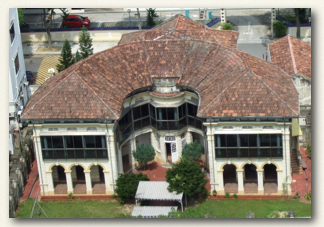
butterfly-house.jpg

23 June 2007 -Summary carried by Irene Low

After an active campaign and many months of waiting, the developer has finally published its proposals for 23 Amber Road, the Butterfly House. According to the proposal, only a small portion of the Butterfly House comprising the porch and stairhall structure will be saved. The proposal allows the developer to destroy the rest of the building, including the distinctive crescent portion which has given the house the nickname “the Butterfly House”.


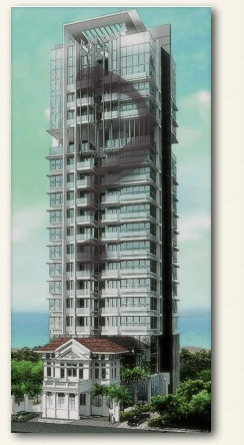
The developer proposes to dovetail an 18 storey modern condominium on the porch to make a hybrid building, which looks like a product of a genetic experiment gone wrong. This Frankenstein building would be an “eyesore on the seashore”.


We encourage you to send your feedback to the proposal to try to save the building in its entirety.

frankenstein.jpg

Several active discussion threads that provide additional information include:

Save 23 Amber Road by Chong-Yee Khoo, a patent attorney, orchid judge and photographer.

Say no to Frankenstein - article in Five Foot Way, dedicated to exploring Asian architecture

Not the first time a Cashin family home has been in the news, as a story carried by SPI confirms.

In the early 1970s, the Government under the Land Acquisition Act as acquired the Maltida House aka Punggol Kampong House from Mr Cashin. Mr Howard Cashin, 82, eminent lawyer and a epitome on the Singapore rugby scene for decades, spent many happy holidays in and around it. It is called Matilda House, named for his paternal grandmother and built by his father, Mr Alexander Cashin, as a present for his wife.

The Punggol seaside bungalow, built in 1921/22 as a weekend retreat for the Cashin family, will be restored and conserved as a landmark and put to community use in Punggol New Town. The house is within a short walking distance from Punggol 21 and, for those old enough to remember, off that narrow winding road that led to those great Punggol Point seafood eateries.

It was in October 2002, Mr Cashin and The New Paper team visited the Matilda house again. Mr Cashin was quite shocked by seeing its present state, and he confessed to being ‘a little shaken’ at seeing it in its present state.

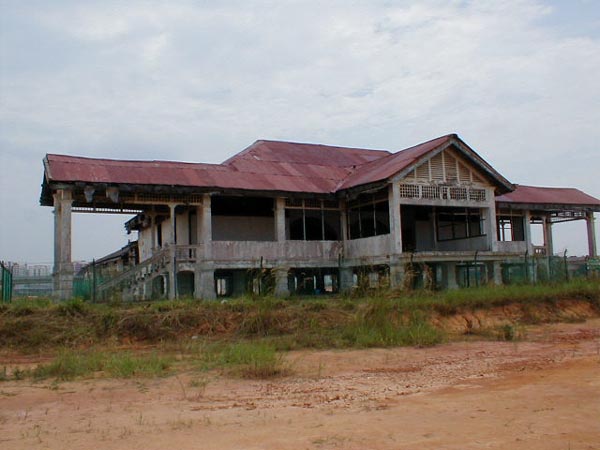
Once it has a glorious past, Matilda house is now situated lonely within the new Punggol LRT loop Note, this was based on an article in 2002, I need to pop down and see what it looks like in 2007

matilda-house.jpg

Categories: Architecture

It’s official

August 4, 2007 · No Comments

Early this week, some residents at Seletar Airbase received written confirmation that their leases will not be renewed beyond December 2008. Thankfully only some of the black & whites will be demolished, the rest will be re-assigned from residential to commercial status to support an aviation training zone. I’m checking with JTC if their mao can be published here, so stay tuned.

Folks at Jalan Kayu Trail have unearthed a couple of old photos depicting the shophouses in the 1950s.

Looking ahead, we have a lunar eclipse coming up on August 27th/28th. The views from Seletar Airbase should be spectacular, as we do have less light pollution than the built up areas of the island.

Fans of Seletar have begun their final pilgrimage, it seems. Some images from Kok Sheng’s recent visit, of the buildings, and birds. And dubbie’s flickr album

Categories: Seletar Aerospace Hub